CAS CS 351 - Distributed Systems
Detailed Lecture Notes
Lecture 1: Threads and Processes
A distributed system is defined as a system wherein processes or components of that system communicate via message passing.
However, in order to program such a system, we immediately run into inefficiencies if we write single-threaded programs (as you probably have been doing up until this point).
Why Multi-Thread?
Consider the following example. Let’s say we have three satellites and a command center on earth. The satellites are constantly performing measurements of their current distance to the moon. We want our command center on earth to poll the three satellites for their reading list, average the readings, and then report a list of the three averages, one per satellite.
If we write this serially, our program might look something like this:
for s in satellites:
    end_msg(to: s, "update?")
    res := wait_response()
    sum := 0
    for record in res.records:
        sum += record append(sum/len(res.records))
But consider, what happens if one of our three satellites is down? wait_response() may block forever!
Also consider, are we wasting time? The answer is– probably yes! Imagine that receiving a response can take anywhere from 1-6 seconds, and calculating the average takes about 1 second. Ideally, we would like to send all our requests out at the same time.
For example, if one satellite responds in 1 second, one responds in 4 seconds, and one responds in 2 seconds, how long would it take serially?
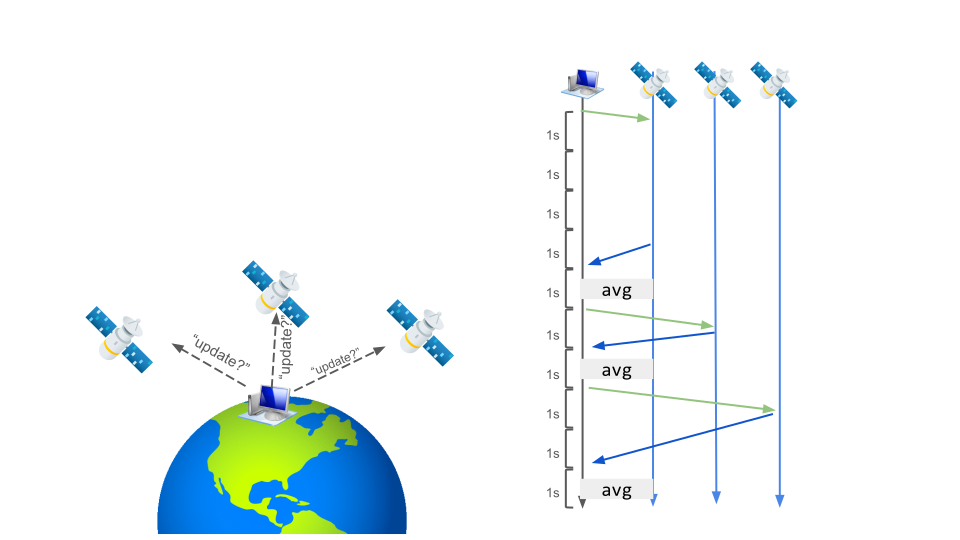
1+1 + 4 + 1+2+1=10 seconds!
But consider if we sent out all requests at the same time?
Well, after 1 second we receive satellite_1’s response, and calculate the average in additional 1 second. Right when we are done averaging we get satellite_3’s response, and one second of averaging. And then finally, we receive satellite_2’s response and average that one. How long is our process now?
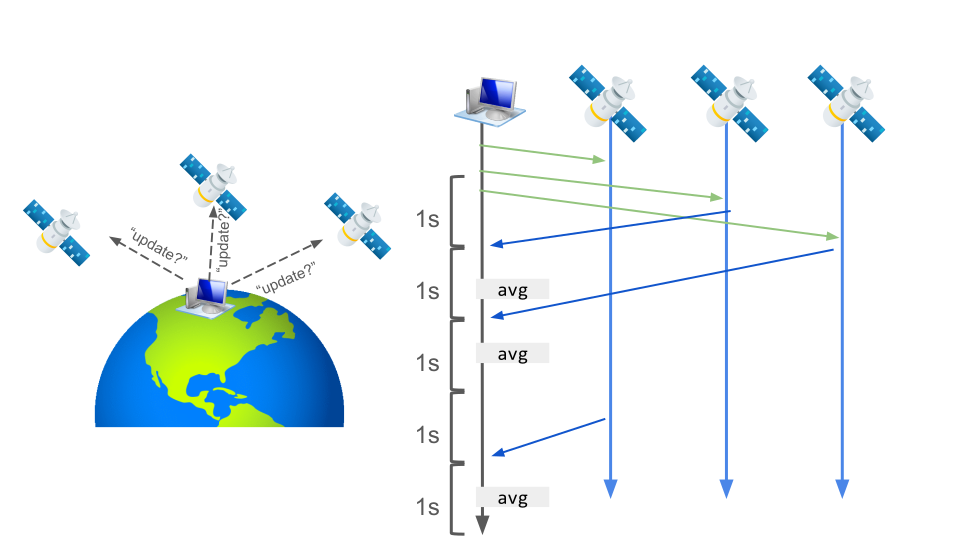
1+1+1+1 (idle)+1 = 5 seconds!
Clearly, in a distributed system where communication time is non negligible, it is important we write code in a way that it can be run simultaneously. Ideally, we would want three small programs running at once– one that sends messages and averages the response for each of the three satellites. This small program can be called a thread.
Threads and Processes
What is a thread? In order to answer this question completely, we must remember from CS210, what is a process?
A process is a running program. The operating system manages processes. The operating system allows many running processes to seamlessly share a fixed set of hardware devices. The operating system interrupts running processes and interleaves these running processes so that each process has a fair turn, running on the CPU. Deciding which processes run on the CPU is known as scheduling.
The operating system also facilitates the isolation of memory between processes. The operating system manages the page table, a data structure through which each memory lookup goes through. Processes have instructions with memory addresses. The addresses that the process uses are virtual addresses. These virtual addresses are then translated via the page table to physical memory addresses to lookup in RAM.
So what is a thread? A process may have multiple threads (a process has a single thread by default). These threads are scheduled independently by the operating system. Two or more threads of the same process may run simultaneously or be arbitrarily interleaved. The decision of what thread to run at what time is up to the operating system. The operating system notes when threads are waiting for resources, like a response over the network, and can spend CPU time progressing on a different thread!
Another key feature of threads is that threads of a process share the same virtual address space. This means that two threads of the same process have access to the same memory, the same data, the same variables. Shared memory is a big advantage– we don’t need to worry about message passing or the like in order to communicate between threads. However, unfettered access to shared memory can cause problems, like data races.
Goroutines
So how do we program a multi-threaded program? Golang, fortunately, is a language that was designed with concurrency as a main priority. The keyword go in golang creates a new goroutine to execute a provided function call.
Goroutines are similar, but not directly analogous to threads. Goroutines are the unit of concurrency in the go programming language. Like threads, they are scheduled independently meaning that they can run simultaneously or in an interleaved fashion when one goroutine is blocked. Also like threads, two goroutines of the same go process share memory, they can share any data that is in-scope for both function calls.
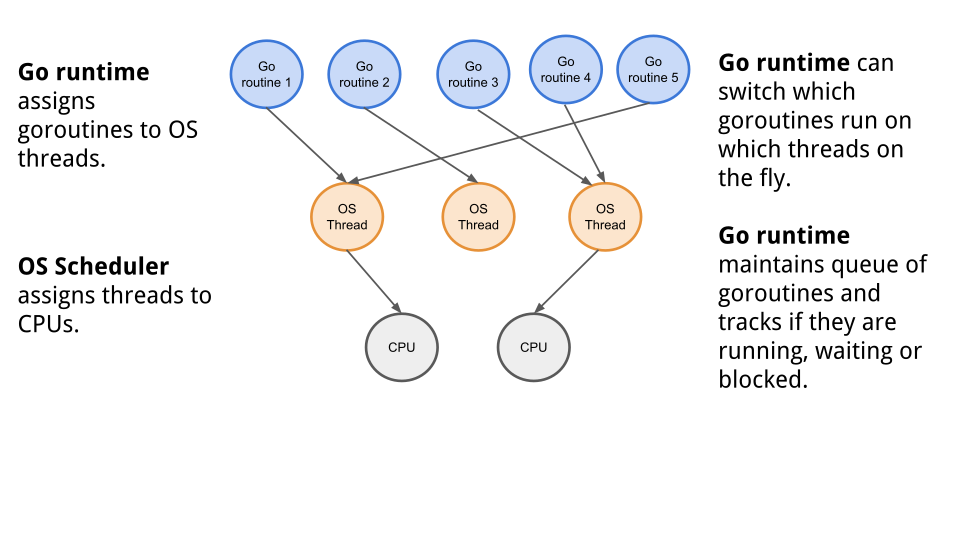
Goroutines differ from threads in how they are scheduled and managed. Instead of the operating system scheduling goroutines, the go runtime is responsible for scheduling goroutines and schedules them on top of OS threads. Operating system scheduling is costly– to run OS code we need to perform a context switch, saving all information and interrupting the running process. However, the go runtime runs entirely in userspace, meaning that its scheduling decisions are much more efficient. The go runtime is free to switch go routines from running on top of one OS thread to another without a context switch. Because of this feature, goroutines are lightweight compared to threads, it is easy to have 100K goroutines without seeing memory problems or performance issues.
Go Routine Example
func worker(i int) {
	fmt.Println("%v", i);
}

func main() {
	for i:=0; i < 100; i++ {
		go worker(i)
    }
// time.Sleep(1 * time.Second)
}
Let’s now consider the above snippet of code.
What would happen if we were to run this code sequentially (removing the go keyword)? In this case, we would see the numbers 0 to 100 printed in order.
What happens if we run this code, as is, with the time.Sleep commented out? In this case, maybe a few numbers would print, but we would likely not see 100 numbers (or any numbers at all)! This behavior occurs because the main method of our go program may complete before all (or any) of our worker goroutines print!
Now, what would happen if we run this code with the time.Sleep uncommented? In this case, all the numbers 0 to 100 would be printed, but not in order! The order in which the goroutines are scheduled/ran is dependent on the go runtime scheduler. We can not reason or guarantee this order.
Notice, using time.Sleep is poor practice. Instead, it is better to opt to use concurrency control primitives in order to have one thread wait for another to complete.
Concurrency Control Primitives
When two or more concurrent threads access the same data, and one of those threads performs a write, we have a data race.
Consider the two following threads:
Thread 1:
    sum = 2 + 4 + 6
    print("avg =", sum / 3)
Thread 2:
    sum = 7 + 3
    print("avg =", sum /2)
There are two shared variables, sum and avg, and perform reads and writes to both variables in the two threads. What might happen?
Serially, if we run thread 1 in it’s entirety then, thread 2 in it’s entirety, we would get the following:
avg = 4
avg = 5
But what happens in the multi-threaded setting?
Well, it is possible we set sum = 12, then run thread 2, set sum = 10, print avg = 5, then finally print avg = 10/3!
avg = 5
avg = 3.3333
So how do we avoid unwanted data races? Well, there may be certain sections of code where we want concurrency control. Concurrency control involves limiting simultaneous execution of specific sections of critical code.
Locks
One tool for concurrency control is known as a lock or a mutex (standing for mutual exclusion).
A lock allows for only one thread to acquire the lock and progress past a blocking lock statement. Any other threads that call lock on that lock will block until the holding thread releases the lock.When a thread holding the lock calls unlock exactly one other thread may succeed in acquiring the lock and unblocking to progress.
# Thread 1:
    lock.Lock()
    sum = 2 + 4 + 6
    avg = sum / 3
    print("avg = ", avg)
    lock.Unlock()

# Thread 2:
    lock.Lock()
    sum = 7 + 3
    avg = sum / 2
    print("avg = ", avg)
    lock.Unlock()
With this scheme, if we run the two threads concurrently, we may now see:
avg = 4
avg = 5
or we may also observe:
avg = 5
avg = 4
As it is possible that either thread may execute first, succeeding in acquiring the lock. However, it is not possible for the two threads to simultaneously execute the section in between the acquire/release statements.
Channels
In golang another useful concurrency control primitive is a channel. A channel allows for two goroutines to pass and receive messages or data. Using a channel often eliminates a shared variable (thus eliminating a data race), and instead requires goroutines to send partial results or computations to some accumulator goroutine via the channel.
chan <- is the send channel operator. This will block if the channel is full (by default the buffer size of the channel is 0 and this will block until someone reads from the channel).
<- chan is the receive channel operator. This will block if there is nothing to read from the channel.
make(chan T) creates an unbuffered channel (size 0, will block writing until someone reads from channel).
make(chan T, N) creates a buffered channel of size N. N messages may be written to the channel without blocking. Once full, writers will block until space in the channel buffer opens up.