CAS CS 351 - Distributed Systems
Detailed Lecture Notes
Lecture 12: Distributed Consensus III
In this section we will continue to explore the more nuanced interactions in Raft. We will elaborate on the implementation of AppendEntries for receivers, explore what can happen when partitions in the network occur, and finally understand why having a log entry exist on a majority of servers is not one-to-one with it being eventually committed.
Resolving Inconsistencies with AppendEntries
We must consider: is it possible that two entries, at the same index, across different logs, may conflict (represent different operations)? If so, what is our plan to reconcile this inconsistency?
If we investigate, we will see that yes– it is possible for two log entries at the same index to conflict, as they may come from different terms!
However, it will only be possible for at most one of these log entries to be committed at that index. Then, we must have a mechanism within Raft to reconcile these inconsistent log entries.

Consider that server 2 and server 3 have conflicting log entries for index 3. We can have conflicting log entries, for example, if server 2 was leader, but failed before sending appendEntries regarding the index 3 log entry. Notice that, at this point, neither log entry in index 3 is committed.
Now, the implementation of the receivers logic for AppendEntries adds the following logic:
- If an existing entry conflicts with a new one (same index but different terms), delete the existing entry and all that follow it (§5.3)
- Append any new entries not already in the log
The effect of rules 3 and 4, enforce that followers will delete conflicting log entries and eventually update their logs to match the leaders. This behavior works well with the fact that leaders are guaranteed to have all committed log entries in Raft. We are free to delete and discard uncommitted log entries, as clients do not expect that these entries are replicated or successful at this point.
###
Partitions
Is it possible for there to be two servers who believe they are leaders simultaneously in Raft? Surprisingly, the answer is yes, however, not for the same term.
Consider the following interaction:
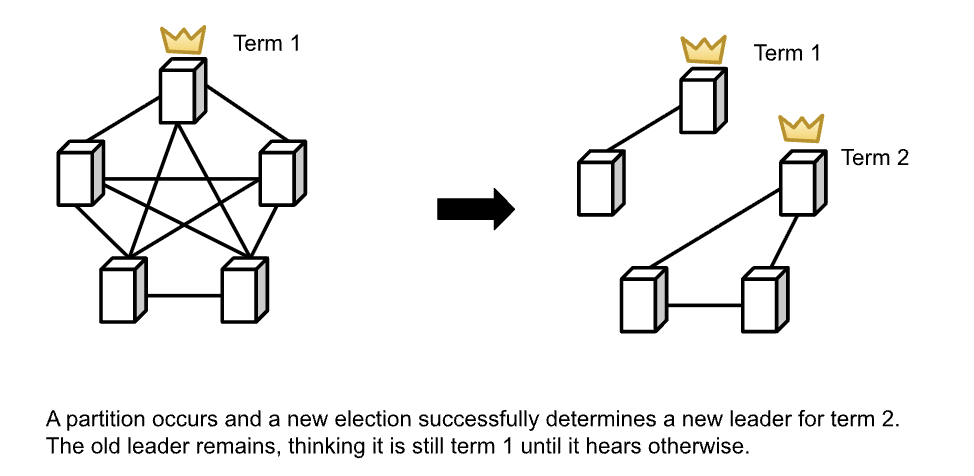
Notice that servers A and E will remain connected, happily sending heartbeat appendEntries back and forth, never triggering a new election.
However, B, D and E, fail to receive heartbeats, and as such, they start an election. When an election succeeds, we will elect a new leader in this majority partition (3 servers is enough to elect).
So, at this point in time, we have two leaders (the old one who believes it is term 1 and the new one who knows about term 2). However, is this a problem?
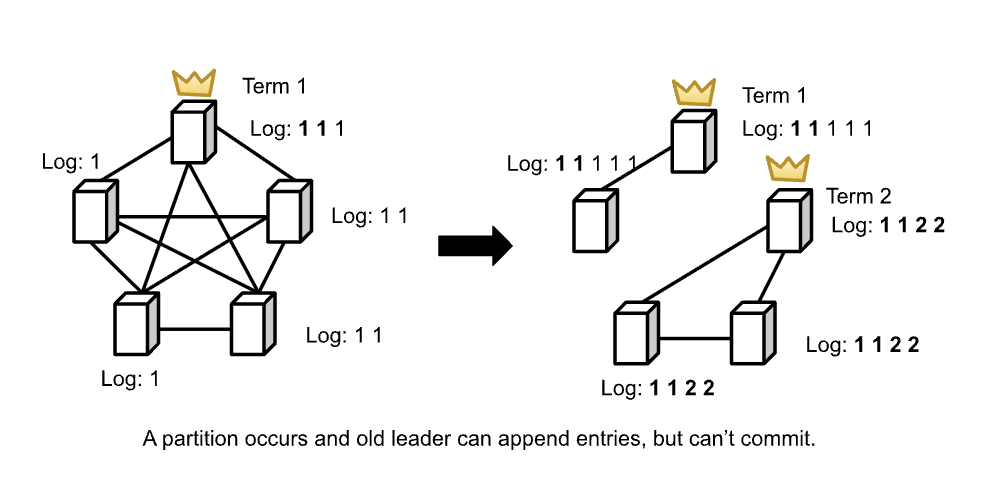
Notice that the old leader from term 1 cannot commit any entries. Thus we will not have a diverging application state. Though Raft allows for two leaders to exist at one time, only one leader, at most, will be able to commit.
When the partition heals, the A and E will be brought up to date and receive the entries they missed.
Committing Entries from Previous Terms
A troubling question in Raft is: can we be sure an entry will be committed if it exists on a majority of servers? Our intuition may say yes, however, as we have learned, there is a mechanism for catching up followers, and we need to add an additional rule to guarantee the safety of Raft’s committed entries.
Up until this point, our understanding of updating commitIndex has been:
- If the leader knows that a majority of followers have a specified entry replicated in their logs, update
commitIndex.
However, if we reference the Raft paper, there is an additional caveat in the leader’s logic for updating commitIndex:
If there exists an N such that N > commitIndex, a majority of matchIndex[i] ≥ N, and log[N].term == currentTerm: set commitIndex = N.
This bolded portion of the rule describes that we may only update commitIndex in this way such that our for new commitIndex, N, log[N].term == currentTerm. In other words, we may only update commitIndex to a log entry from the current term.
Why do we need this additional rule? The intuition can be highlighted in the following interaction:
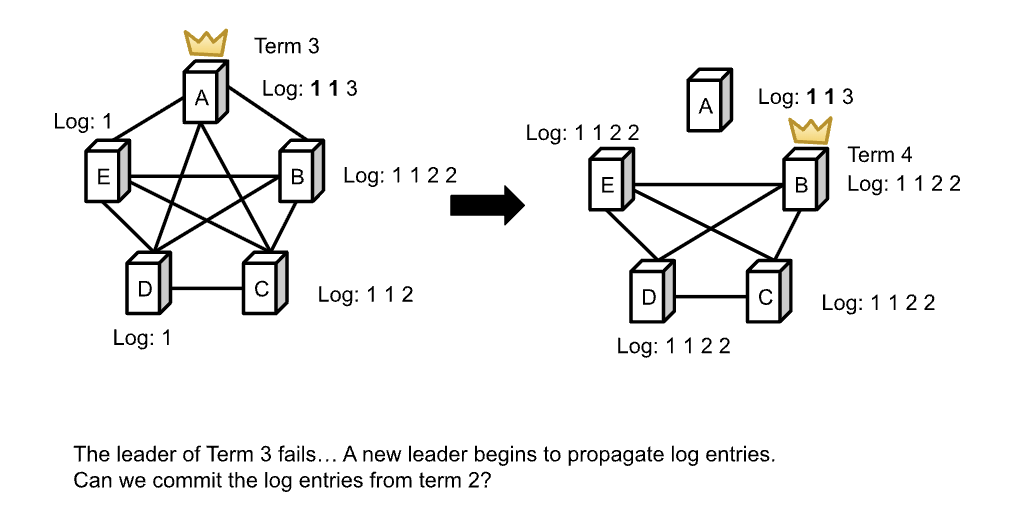
In the above image, we have server A who is currently the leader. Consider that A,D,E must have been the group of servers to elect A (because B and C have entries from 2, they would not have thought A was up to date). But 3 servers is enough for a majority– thus A can be elected.
Then, consider that A may be disconnected from the cluster before propagating the entry from term 3. Now, who may be elected? B or C (as they can get votes from E,D). Say server B is elected for term 4. Now, B goes about sending AppendEntries rpcs to update E and D. Once the [2 2] log entries have been propagated (as in the second picture) can we update commitIndex to 4?
No! (The currentTerm == 4 which does not equal 2). But why would it be dangerous to commit these entries? Let’s see:
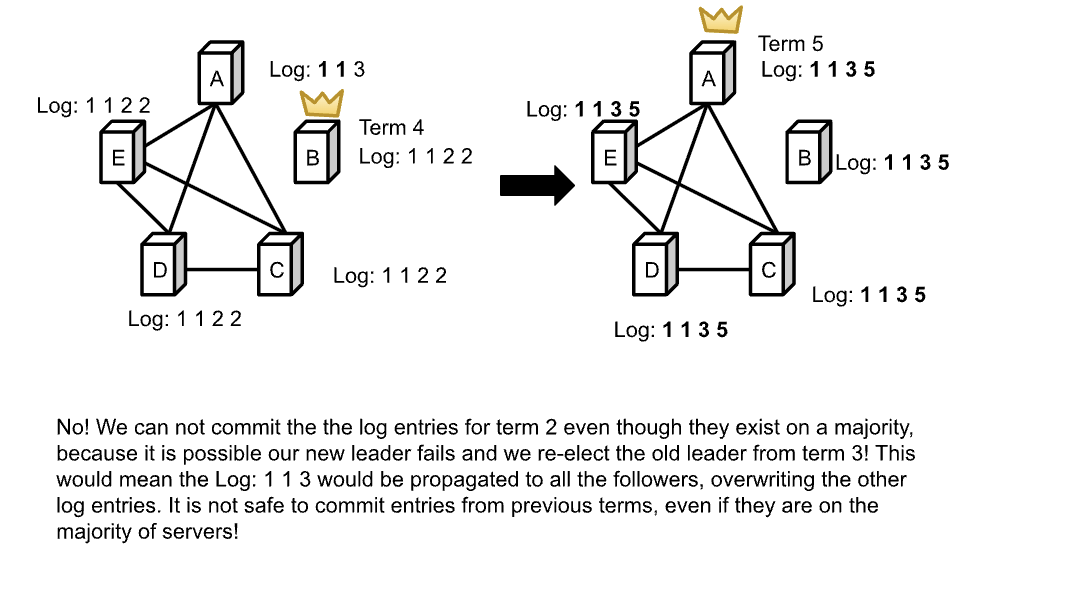
In the above example, B is disconnected from the group, and A is elected leader again. Notice that log [1 1 3] is more up-to-date than [1 1 2 2], by the rule regarding the term of the last index. Once A is elected leader, it will propagate AppendEntries to bring followers to match it’s log. Notice that the previous [2 2] log entries are overwritten.
However, notice that we only commit for example, entry 3 in term 5, once a preceding log entry from term 5 is committed.
See Figure 8 in the raft paper for an additional example of the above interaction.
Persistence
- In order to facilitate servers rejoining the raft cluster after temporary failure we must persist (save) some state in non-volatile storage.
- Aside: Non-volatile storage is something like a hard disk, whereas RAM (main memory) will be wiped when the computer loses power!
- Remember, when a server comes back from failure, the only information it will have is the persisted state!
- Saved in non-volatile storage each server has:
- currentTerm latest term server has seen (initialized to 0 on first boot, increases monotonically)
- votedFor candidateId that received vote in current term (or null if none)
- log[] log entries; each entry contains command for state machine, and term when entry was received by leader (first index is 1)
- Notice what is in volatile state:
- commitIndex index of highest log entry known to be committed (initialized to 0, increases monotonically)
- Notice, we will recreate commitIndex via AppendEntry rpcs as the leader verifies which servers have replicated various log entries and/or we hear about the leader’s commit index.
- lastApplied index of highest log entry applied to state machine (initialized to 0, increases monotonically)
- Notice that lastApplied should have the same persistence as application state. By default, the underlying application state in raft is not persisted. Thus, to recover our application state after failure, it is a feature that we reset lastApplied and re-apply each operation to recreate our state.
- commitIndex index of highest log entry known to be committed (initialized to 0, increases monotonically)
- Note, that persistent state must be updated before responding to RPCs with “success” message
- What happens when a server recovers from failure?
- If they already voted in an ongoing election, this information is saved via currentTerm and votedFor. This is necessary to avoid having servers vote multiple times in an election (which would break our rules about majorities!)
- The server will start in
followerstate - If contacted by leader with greater or equal term, will update term (if needed) and continue as normal
- The leader will catch up the recovered server with the typical appendEntries plan.
- The leader always sends lastTerm and lastIndex, to ensure the follower and leader agree on the previous item in the log, before appending a new item.
- This rule catches up followers if they conflict or have a shorter log.
- If no server contacts the follower, they will timeout and start election, as normal.
Snapshots
- What happens when the log gets too long?
- Snapshots save the system state at a current instant in time.
- All the committed operations in the log went to create this snappshotted state.
- Notice: if we save the snapshotted state, it is safe to delete the log entries.
- Then, we can truncate the log (all the operations that went to make the current snapshot of the system state).
- Note, we can only snapshot the log up to the commitIndex.
- Leaders and followers can snapshot their state independently– this is an internal operation.
- Raft defines a helper RPC,
InstallSnapshot, which catches up followers via a saved snapshot, as perhaps they may have missed committed log entries in the snapshot and now need to be caught up via the snapshotted state itself.
Building Applications on Top of Raft
- Key Idea: In Raft, each server in the raft cluster is identical. They all perform the same operations and have the same data. A raft cluster, is a cluster of replicas.
- We can not perform raft across servers who run different operations or have different functionalities.
- If we want to add fault tolerance to a single server in our application, let’s say we have a single flight booking service server.
- We can:
- register_flight(time, day, locale, num_seats) -> flight id
- delete_flight(flight_id)
- book_set(flight_id) -> yes/no
- query_flights(locale) -> [flights]
- We would replace the single master server with a cluster of say 5 servers running the Raft protocol.
- Then clients would submit the register_flight, delete_flight, book, or query operations to the leader of the raft cluster.
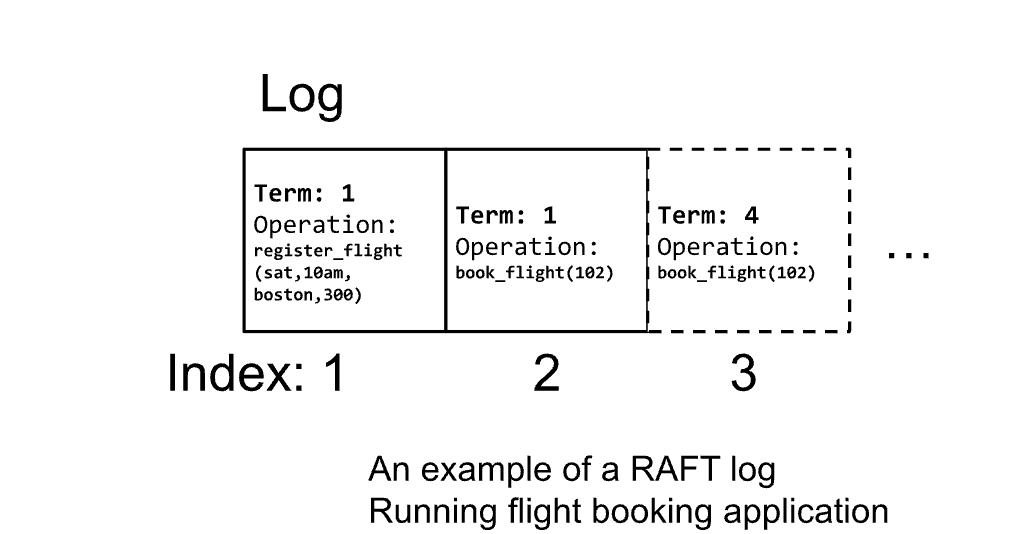
- If a single raft server fails, no problem! Raft will handle either re-electing a leader, or succeed in committing log operations with the majority.
- We can:
- Now, say we have two servers, one which is responsible for booking and querying flights. The other server is the flight database.
- We could not use RAFT protocol across the two servers, as they perform different operations!
- We would need to use RAFT to replicate each service independently! For example:
- A raft cluster of 3 servers for the booking/querying service
- A raft cluster of 5 servers for the flight database service